



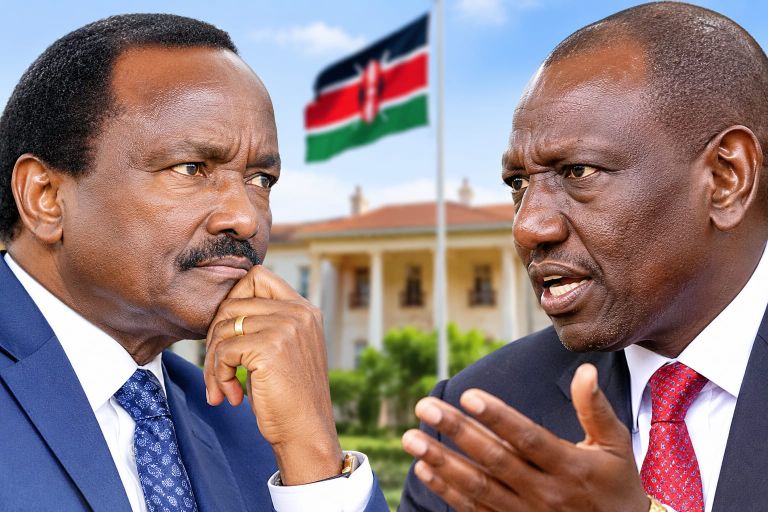
President William Ruto’s allies appear increasingly keen on bringing Wiper Party leader Kalonzo Musyoka into their political fold as the battle to shape alliances ahead of the 2027 General Election gathers momentum.
The renewed push to draw Kalonzo closer to the President’s camp emerged during a heated political discussion on Citizen TV’s Daybreak on Monday, November 2, 2026, where Belgut MP Nelson Koech openly questioned why the veteran opposition politician continues to lead his supporters in opposition despite his long political career.
Koech, a vocal supporter of Ruto and chairperson of the National Assembly’s Departmental Committee on Defence, Intelligence and Foreign Relations, suggested that Kalonzo should reconsider his political positioning instead of remaining aligned with the opposition.
📊 Channel 15 News Opinion Poll
“It is wrong for a senior person like Kalonzo to still lead his supporters to the opposition. He has been there for long enough and is almost a career Deputy President and running mate,” Koech said.
His remarks have renewed attention on the political significance of Kalonzo, whose influence and position within the opposition make him an important figure in the emerging contest over the country’s next leadership.
With political alliances gradually taking shape ahead of 2027, the question of where Kalonzo eventually stands could have far-reaching implications for both the government and opposition camps.
For Ruto’s allies, attracting the Wiper leader into their fold would potentially alter the political calculations surrounding the next presidential contest. For the opposition, retaining Kalonzo could prove important in efforts to build a united alternative to the Kenya Kwanza administration.
However, Makueni Senator Dan Maanzo dismissed suggestions that Kalonzo was considering joining Ruto’s political camp, insisting that the Wiper leader had already made his position clear.
“No. There is nothing direct. He has already said no and a no is a no,” Maanzo said when asked whether there had been a direct approach to Kalonzo to join the President.
Maanzo further invoked Kalonzo’s position on the deaths of young Kenyans during anti-government protests, saying the opposition leader had declared that he would never dance on the graves of Gen Z protesters who died under Ruto’s administration.
Kirinyaga Woman Representative Njeri Maina also dismissed the prospect of a political partnership between the two leaders, arguing that they were moving in opposite political directions.
“William Ruto and Kalonzo Musyoka are on completely different trajectories; where the President is on a downward spiral and Kalonzo Musyoka on an upward spiral,” Maina said.
She further questioned what the President’s camp could offer Kalonzo, arguing that the Deputy President position had been politically devalued.
The discussion also exposed the widening political differences surrounding former Deputy President Rigathi Gachagua and his relationship with the opposition leadership.
Koech questioned why Gachagua had visited Wamunyoro rather than Kalonzo’s residence, arguing that the move suggested a weaker political position.
“I would have expected Rigathi Gachagua to have visited Kalonzo Musyoka’s residence. For him to have gone to Wamunyoro, somehow, shows that he went as a weaker person,” he said.
In a further prediction, Koech claimed that Gachagua could eventually become the first opposition figure to reconcile with Ruto’s government after the next General Election.
“Do not be surprised to find out that Rigathi Gachagua will be the first one to have a handshake with William Ruto’s government after the next general election,” he said.
The exchanges highlight the growing contest over political alliances as Kenya moves towards the 2027 elections, with Kalonzo’s next political move likely to attract considerable attention from both sides of the political divide.
