


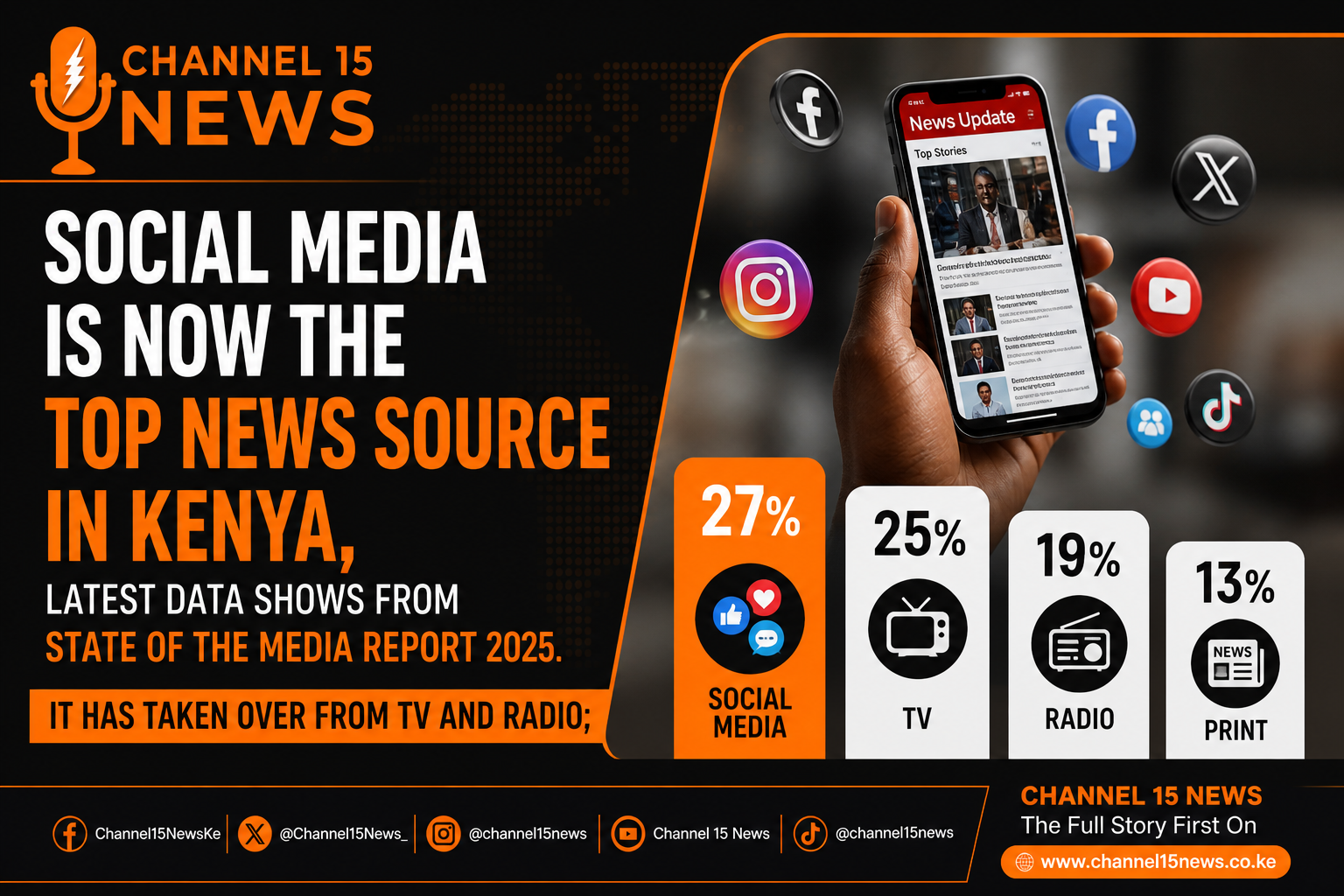
Social media has officially become the dominant source of news for Kenyans, overtaking traditional platforms in a major that is reshaping the country’s media landscape, according to the State of the Media Report 2025.
The report reveals that 39% of Kenyans now rely on social media as their primary source of news, marking a decisive shift in how information is consumed in the digital age. This places platforms such as Facebook, X, TikTok and WhatsApp at the center of public discourse, ahead of long-established media channels.
Television, once the undisputed leader in Kenyan households, now ranks second at 25%, reflecting a steady decline in viewership as audiences migrate online. Radio, historically the most accessible and widely consumed medium—especially in rural and peri-urban areas—accounts for 19%, while print media trails at 13%, underscoring the rapid erosion of legacy platforms.
The data signals more than just changing audience habits—it points to a structural transformation in Kenya’s information ecosystem.For decades, mainstream media houses dictated the news agenda, operating as gatekeepers of information.
Today, that power is increasingly decentralized, with millions of Kenyans accessing real-time updates directly from their smartphones. The rise of social media has democratized news dissemination, but it has also raised concerns about misinformation, credibility, and the weakening of editorial standards.The shift comes at a particularly difficult time for traditional media organizations.
The industry has been grappling with deep financial strain, leading to widespread layoffs that have seen hundreds of journalists lose their jobs in recent years.
At the same time, regulatory pressures have intensified, with the Communications Authority of Kenya (CA) revoking the licences of 75 broadcasters, further shrinking the operational space for conventional media players.
Analysts say the surge in social media consumption is no longer a gradual trend but a full-scale disruption that threatens the sustainability of traditional journalism as it has been known.
As audiences continue to migrate online, media houses are being forced to rethink their business models, invest in digital-first strategies, and find new ways to remain relevant in an era where speed, accessibility, and engagement often outweigh depth and verification.
The message from the latest report is clear: Kenya’s news consumption habits have fundamentally changed—and the media industry must adapt or risk being left behind
