


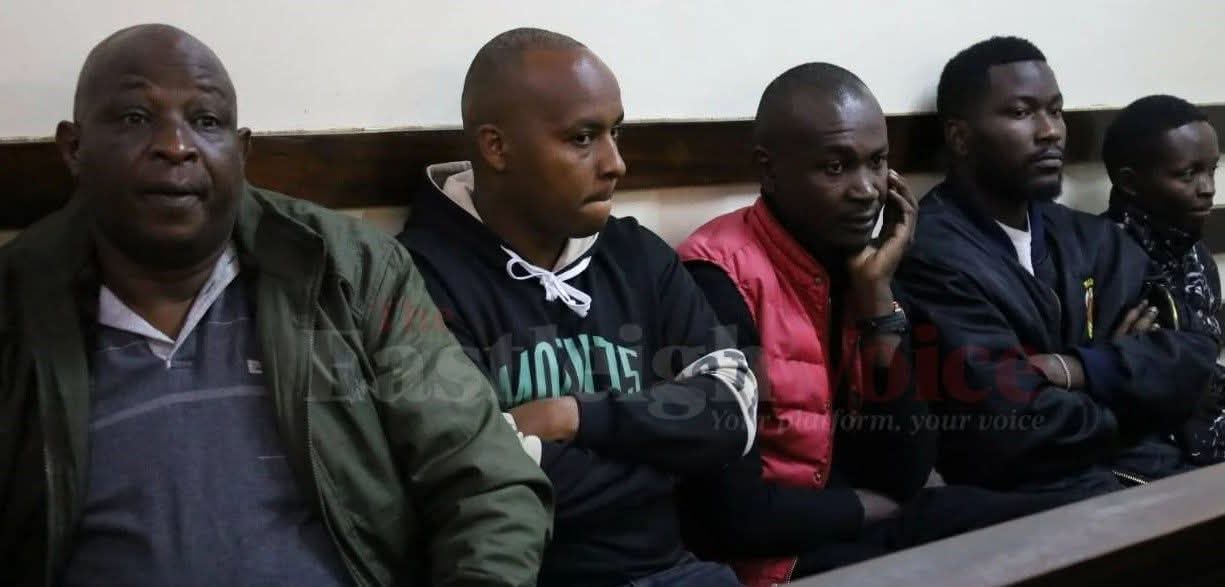
Interdicted Nairobi Central Police Station OCS Samson Kiprotich Talaam, Police Constable James Mukhwana, and four other individuals accused of the brutal murder of blogger and teacher Albert Omondi Ojwang will remain in custody until September 26, 2025, following a ruling by High Court Judge Diana Kavedza sitting at the Kibera High Court.
Judge Kavedza declined to release the accused persons on bail after a pre-bail report recommended they be denied freedom pending trial. The six—three police officers and three civilians—had applied for bail after pleading not guilty to murder charges brought against them on June 24, 2025.
Ojwang, who was arrested on allegations of defaming Deputy Inspector General of Police Eliud Lagat on social media, died on the night of June 8 while in custody at the Nairobi Central Police Station. Initial police statements claimed the death was a suicide, but an independent postmortem revealed that Ojwang died from blunt force trauma, pointing to torture and physical assault.
The accused are:
Samson Kiprotich Talaam, former OCS of Nairobi Central
James Mukhwana, a police constable
Peter Kimani, another officer
John Ngige Gitau (alias “Kinara”), a known police informer
Gin Ammitou Abwao (alias “Gilbeys”)
Brian Mwaniki Njue
They are charged under Sections 203 and 204 of the Penal Code, which provide for a maximum penalty of death upon conviction.
During the bail hearing, Prosecutor Victor Owiti, appearing for the Office of the Director of Public Prosecutions (ODPP), opposed the release of the accused. He cited the gravity of the offence, the risk of interference with witnesses, and the possibility that some of the suspects could tamper with evidence, including CCTV footage, which was found to have been deliberately disabled at the time of Ojwang’s detention.
Investigations by the Independent Policing Oversight Authority (IPOA) revealed that key surveillance equipment had been tampered with, cables disconnected, and technicians allegedly bribed to obstruct justice. IPOA also noted that Ojwang had been severely beaten while in custody and that orders had allegedly come from senior ranks.
In a startling affidavit presented during earlier court proceedings, PC James Mukhwana reportedly claimed that he was acting under instructions from both OCS Talaam and Deputy IG Eliud Lagat to discipline Ojwang, who had posted critical content about senior police officers online. These allegations have raised broader concerns about abuse of power and extra-judicial punishment within the police service.
The High Court had earlier ordered all six suspects to undergo mental assessments at Mathare Hospital and directed the probation department to compile a pre-bail report, which has now been delivered and relied upon by Justice Kavedza in her ruling to keep them in remand.
Earlier attempts by OCS Talaam and PC Mukhwana to block their prosecution through a High Court petition at Milimani were unsuccessful. Justice Lawrence Mugambi ruled that since the criminal proceedings were already active at Kibera High Court, the matter would be better handled there to avoid judicial conflict. The petition was thus transferred to Kibera.
Prior to the bail denial, the suspects had been detained for several weeks under orders from Milimani Magistrate Ben Mark Ekhubi, who extended Talaam’s detention multiple times to allow IPOA to conclude its forensic investigations and trace tampered digital evidence.
Albert Ojwang’s death sparked nationwide outrage and condemnation from civil society, human rights groups, and members of the public who viewed it as another case of state-sponsored brutality. Protests were held in several towns, and under mounting pressure, Deputy IG Lagat temporarily stepped aside pending further investigations into his alleged role in the matter.
With the case now scheduled to return to court on September 26, 2025, IPOA continues its probe, and the ODPP may file additional evidence or charges. The case is widely viewed as a litmus test for Kenya’s commitment to police accountability and the protection of civil liberties in the digital age.
