




A sitting Governor and his own Agriculture CECM are pursuing the same senatorial seat, with claims of growing unease within the county administration raising questions about political loyalties, internal pressure and the future of their working relationship.
An unusual political contest is unfolding within the Kitui County Government, where Governor Dr Julius Malombe and his Agriculture and Livestock Executive Committee Member, Dr Stephen Mbaya Kimwele, are positioning themselves for the same elective seat in the 2027 General Election.
The two leaders, who currently serve in the same county administration and are associated with the Wiper Patriotic Front, are eyeing the Kitui senatorial seat currently held by Enoch Wambua.
But beyond their competing ambitions, questions are emerging about the political atmosphere within the county executive, with sources familiar with developments in the administration pointing to an increasingly uncomfortable situation involving the two leaders.
Of particular interest are claims that some fellow County Executive Committee Members (CECMs) and chief officers are reluctant to openly endorse Kimwele’s Senate ambition for fear that supporting a candidate competing against their boss could attract displeasure or possible administrative repercussions.
Neither Malombe nor Kimwele has publicly acknowledged a breakdown in their working relationship. However, their overlapping political interests have introduced an unusual dynamic into an administration expected to continue working together until the end of its current term.
The question now is whether the two leaders are still reading from the same political script.
Two Ambitions, One Senate Seat
Interestingly, Kimwele’s interest in the Kitui Senate seat predates Malombe’s public declaration.
In July 2026, The Star reported that Kimwele was among several senior county officials who had declared interest in elective positions, with the Agriculture CECM targeting the Senate seat.
At the time, Malombe acknowledged that members of his administration had political ambitions, maintaining that they were exercising their constitutional rights.
On October 5, 2026, the Governor formally announced his intention to contest the same position after completing his second gubernatorial term.
Speaking during a development tour of Kitui South, Malombe said he had listened to residents who wanted him to continue serving the county in another capacity.
“I have listened to our people, and the voice of the people, we are told, is the voice of God. I will do as they wish,” he said during a public rally at Imwange.
His entry into the race placed him alongside Kimwele, County Assembly Speaker Kevin Katisya and education investor Muinde Mutukaa, among those reported to have expressed interest in the senatorial position.
The competition presents an interesting political dilemma: a Governor seeking to become senator and a member of his own executive team pursuing the same seat.
Fear Of Openly Backing Kimwele?
Perhaps the most sensitive aspect of the emerging political contest concerns the reported reluctance among some county officials to openly support Kimwele.
Sources within the county administration have told Channel 15 News that some CECMs and chief officers are apprehensive about publicly endorsing the Agriculture CECM’s Senate ambition.
According to the sources, the officials fear that openly backing Kimwele could be interpreted as taking a political position against Malombe, who remains the head of the county administration and is himself pursuing the same seat.
The alleged apprehension raises broader questions about the space available to public officials to exercise their political rights without fear of administrative consequences.
It also places county executives in a delicate position, particularly where professional responsibilities and personal political ambitions intersect.
However, Channel 15 News has not independently established that any official has been punished, threatened or subjected to administrative action for supporting Kimwele.
It remains unclear whether the reported reluctance is driven by actual pressure, political caution or individual decisions by officials seeking to avoid involvement in a contest between their boss and a fellow executive member.
The Governor’s position on whether county officials are free to support competing aspirants within the law is therefore an important part of the unfolding story.
The Wiper Party Complication
The political equation becomes even more interesting considering Malombe’s position as Wiper Party chairman in Kitui County.
The Governor’s position within the party’s county structure introduces another layer of complexity as both he and Kimwele pursue the same senatorial seat under the Wiper political banner.
Their ambitions could eventually test the party’s ability to manage internal competition and determine how its Kitui senatorial candidate will emerge.
Will Malombe accommodate a competitive nomination process involving a member of his own administration?
Will Kimwele proceed with his ambition if it means facing his boss in the Wiper nominations?
And could the party leadership eventually step in to negotiate a political arrangement between the two?
The answers could shape the direction of Kitui’s Senate contest long before the 2027 General Election.
Kimwele’s Quiet Political Strategy
Despite the political implications of their competing ambitions, Kimwele has largely maintained a measured public approach in selling his senatorial agenda.
He has not engaged in a sustained public exchange with Malombe over their competing interests, even as he continues to build his political profile.
In a profile published by Channel 15 News on November 18, Kimwele outlined his professional background in accounting, financial management, corporate leadership and public administration.
His proposed agenda includes strengthening devolution, promoting accountability, improving county representation and advocating for equitable allocation of national resources.
His relatively restrained approach, however, leaves another political question hanging.
Is Kimwele fully committed to challenging for the Senate seat regardless of his boss’s ambitions, or is he positioning himself ahead of possible negotiations before the Wiper nomination contest?
Could he eventually step aside in favour of Malombe, or does he intend to pursue the party ticket to the end?
At this stage, there is no publicly established agreement between the two leaders on how their competing ambitions will be resolved.
Makau Mutua’s Intervention Adds Another Dimension
Malombe’s Senate ambition has also attracted criticism from outside the county administration.
On November 21, 2026, Professor Makau Mutua, President William Ruto’s Senior Advisor on Constitutional Affairs, publicly urged the Governor to reconsider his ambition and allow younger leaders an opportunity to represent Kitui in the Senate.
Mutua acknowledged Malombe’s constitutional right to contest but questioned the governance implications of a former governor transitioning into a Senate position responsible for oversight of county governments.
He argued that the arrangement could raise questions about the independence of oversight, particularly when a former county chief executive would be seeking a position requiring scrutiny of the administration he previously led.
Mutua also cited the experience of former Makueni Governor Kivutha Kibwana, who unsuccessfully contested the Makueni Senate seat after completing his two terms as governor.
His intervention introduced a wider debate about political renewal, generational leadership and whether established politicians should continue moving from one elective position to another.
“Governor, I have no dog in this fight. You are an erudite man and I respect you. But please do the right thing and bow out gracefully,” Mutua appealed. <Cite refs={[“turn162117search0″,”turn162117search10”]}/>
However, the emergence of Kimwele as another contender introduces a different dimension to the debate.
While Mutua’s criticism focuses on Malombe’s transition from Governor to Senator, Kimwele’s ambition presents a direct political contest involving two officials serving within the same county administration.
The KEFRI Moment That Raised Eyebrows
The political conversation gained another talking point during Thursday’s MSMEs and Cooperatives Symposium at the Kenya Forestry Research Institute (KEFRI) in Kitui town.
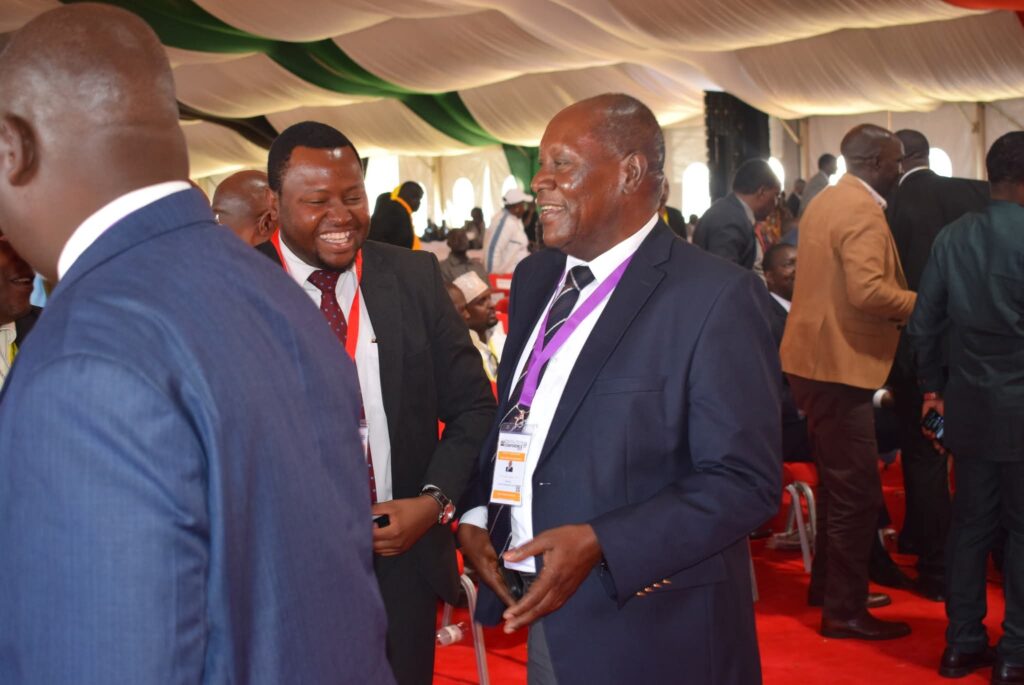
Photographs taken during the November 26 event captured Malombe gesturing towards Kimwele, drawing attention to the two leaders and their overlapping political ambitions.
The images have since become another point of discussion in the unfolding political story.
Against the background of their competing Senate interests, some political observers have questioned whether the moment carried any political message.
Was the Governor simply making an ordinary gesture during a public engagement, or was there an underlying message?
The photographs alone cannot establish hostility, disagreement or a political confrontation between the two. Their significance can only be understood through the wider context and explanations from those involved.
Nevertheless, the images have added another talking point to an already interesting political relationship.
What Happens If Neither Steps Aside?
The unfolding contest presents Wiper with a potentially complicated nomination question.
Malombe has now publicly reaffirmed his Senate ambition, declaring at the KEFRI symposium on November 26 that he would be on the ballot in 2027.
Kimwele, meanwhile, had expressed interest in the seat months before the Governor made his October announcement.
Their competing ambitions could therefore test the party’s ability to manage internal competition while maintaining political cohesion in Kitui.
For residents, however, the bigger concern is whether the emerging political contest will affect the functioning of the county administration.
Can a Governor and his own CECM effectively discharge their responsibilities while pursuing the same elective position?
Do county officials feel free to support an aspirant of their choice without fearing possible administrative consequences?
And can Malombe, as the head of the county administration and Wiper’s Kitui County chairman, accommodate a competitive political process involving his own executive member?
The two leaders now have an opportunity to clarify the state of their working relationship and explain how they intend to navigate their competing political ambitions.
As the 2027 General Election approaches, the Kitui Senate contest is shaping up to be more than a battle between individual aspirants.
It is also raising questions about political freedom within county administrations, party democracy and the relationship between public service and personal political ambition.
Two men are eyeing one seat. But the bigger question is whether their competing ambitions can coexist within the same county government.
