


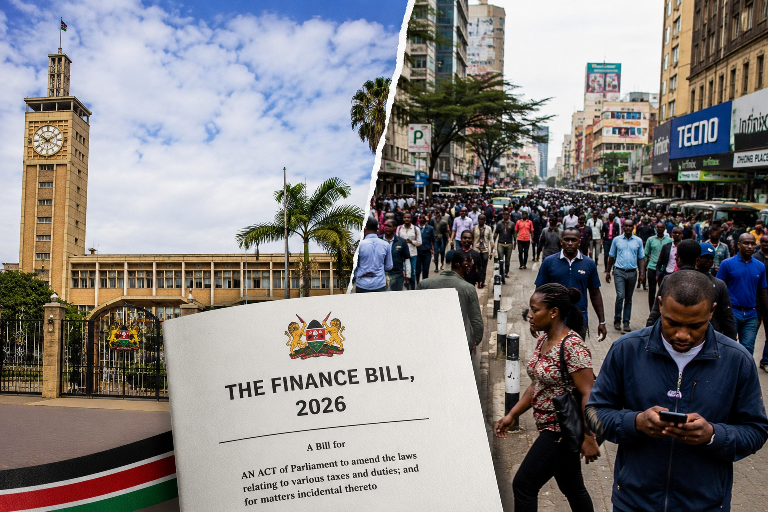
The Finance Bill, 2026 has ignited fresh national debate after the government unveiled a raft of tax proposals expected to touch nearly every Kenyan household, business and sector of the economy.
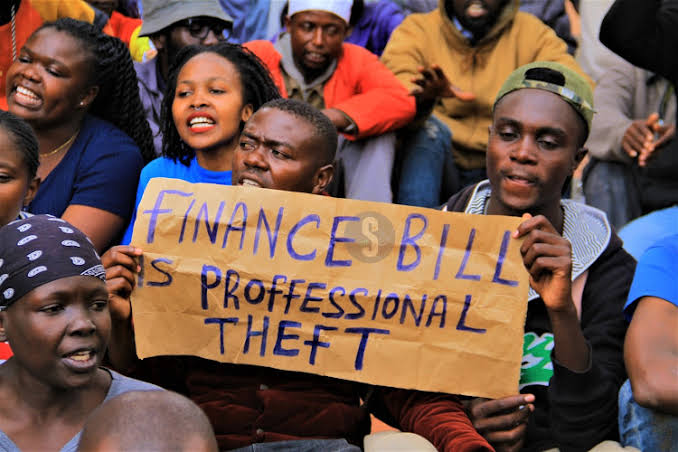
Published on May 5 and now before Parliament, the Bill comes at a politically sensitive moment, less than two years after nationwide protests rocked the country over controversial tax measures contained in the Finance Bill, 2024.
This time, the government is seeking to raise Ksh3.63 trillion in revenue for the 2026/27 financial year while operating with a wider budget deficit projected at 5.3 percent of GDP, up from 4.7 percent in the current fiscal year.
While economists largely agree that Kenya must improve revenue collection to sustain public spending and debt obligations, the emerging concern is whether the burden is once again being shifted disproportionately onto ordinary wananchi, small traders and salaried workers already struggling with a high cost of living.
Among the most contentious proposals is the plan to change income tax filing timelines.
Under the proposed law, annual income tax returns would now be filed by April 30 instead of the current June 30 deadline, while nil returns would be due by January 31.
Tax experts warn that the shortened timelines could place immense pressure on businesses and individuals by reducing the time available for audits, financial reconciliation and compliance preparation.
For thousands of small enterprises operating without sophisticated accounting systems, the proposal is being viewed as yet another costly administrative hurdle.
The Bill has also triggered anxiety within Kenya’s vast mitumba industry after the introduction of a new Section 12H to the Income Tax Act.
The provision seeks to impose a final tax equivalent to 5 percent of the customs value of imported goods, payable upfront before the Kenya Revenue Authority releases the consignment.
Critics argue that the tax disregards the realities of trade where businesses can suffer losses due to weak demand, fluctuating prices or damaged stock.
A trader importing a bale worth Ksh1 million, for instance, would immediately part with Ksh50,000 whether or not they eventually make any profit.Landlords are also set to feel the heat after the Bill proposed increasing residential rental income tax from 7.5 percent to 10 percent.

Analysts warn that unless the government first seals existing enforcement loopholes, the higher rate could simply encourage more tax evasion rather than improve compliance.
Another proposal drawing criticism is the removal of VAT exemptions on money transfer and payment processing services.
The move is expected to increase the cost of digital transactions, directly affecting millions of Kenyans who rely on mobile money platforms and electronic payments for daily business, banking and personal transactions.
Observers say the proposal risks undermining Kenya’s globally celebrated financial inclusion gains by making digital financial services more expensive for low-income users.
The Bill further seeks to expand the definition of management or professional fees to include interchange and merchant service fees for withholding tax purposes.
Industry players fear the additional compliance burden introduced into automated banking systems will ultimately be transferred to consumers through increased transaction charges.
Corporate investors have also raised concerns over proposed amendments empowering KRA to deem at least 60 percent of a company’s undistributed income as taxable dividends.
Business leaders say the measure fails to appreciate legitimate decisions by companies to reinvest profits into expansion, working capital and long-term growth.

There are also fears that the proposal could send negative signals to investors at a time Kenya is aggressively courting foreign and local investment.
In another controversial proposal, the government plans to introduce a 25 percent excise duty on telephones for cellular and wireless networks.
Critics argue that mobile phones are no longer luxury items but essential tools for communication, education, banking, e-commerce and access to government services.
For many Kenyans, however, one of the biggest disappointments is what the Bill does not contain.
Despite earlier expectations that salaried workers would receive relief through revised PAYE tax bands, the proposal is conspicuously absent from the document now before Parliament.
The omission has sparked frustration among employees who had hoped for some breathing room amid rising living expenses and stagnant incomes.Even so, the Bill is not entirely without positive measures.
The reduction of corporate tax for non-resident companies from 37.5 percent to 30 percent has been welcomed as a step toward improving Kenya’s attractiveness to investors.
The extension of the tax amnesty programme to cover liabilities up to December 31, 2025 has also been praised as an opportunity for taxpayers to regularise their affairs without punitive penalties.
Additional relief measures include VAT exemptions on electric buses, bicycles, dialysis equipment, raw materials for animal feed and Public-Private Partnership infrastructure projects.
The Bill also introduces clarity in trust taxation by ensuring beneficiaries are not taxed on income already taxed at the trust level, while gratuity contributions are now recognised as exempt income.
Even with those concessions, pressure is mounting on Parliament to thoroughly scrutinise every clause of the Bill before it becomes law.
Political analysts warn that lawmakers cannot afford to ignore the public mood following the unrest witnessed during last year’s Finance Bill protests.
With Kenyans increasingly sensitive to taxation and the rising cost of living, MPs now face the difficult task of balancing the country’s revenue needs against growing public anger over what many see as punitive economic policies.
As debate intensifies across the country, the Finance Bill, 2026 is shaping up to be not just a fiscal document, but a defining political test for President William Ruto’s administration and Parliament itself.
