



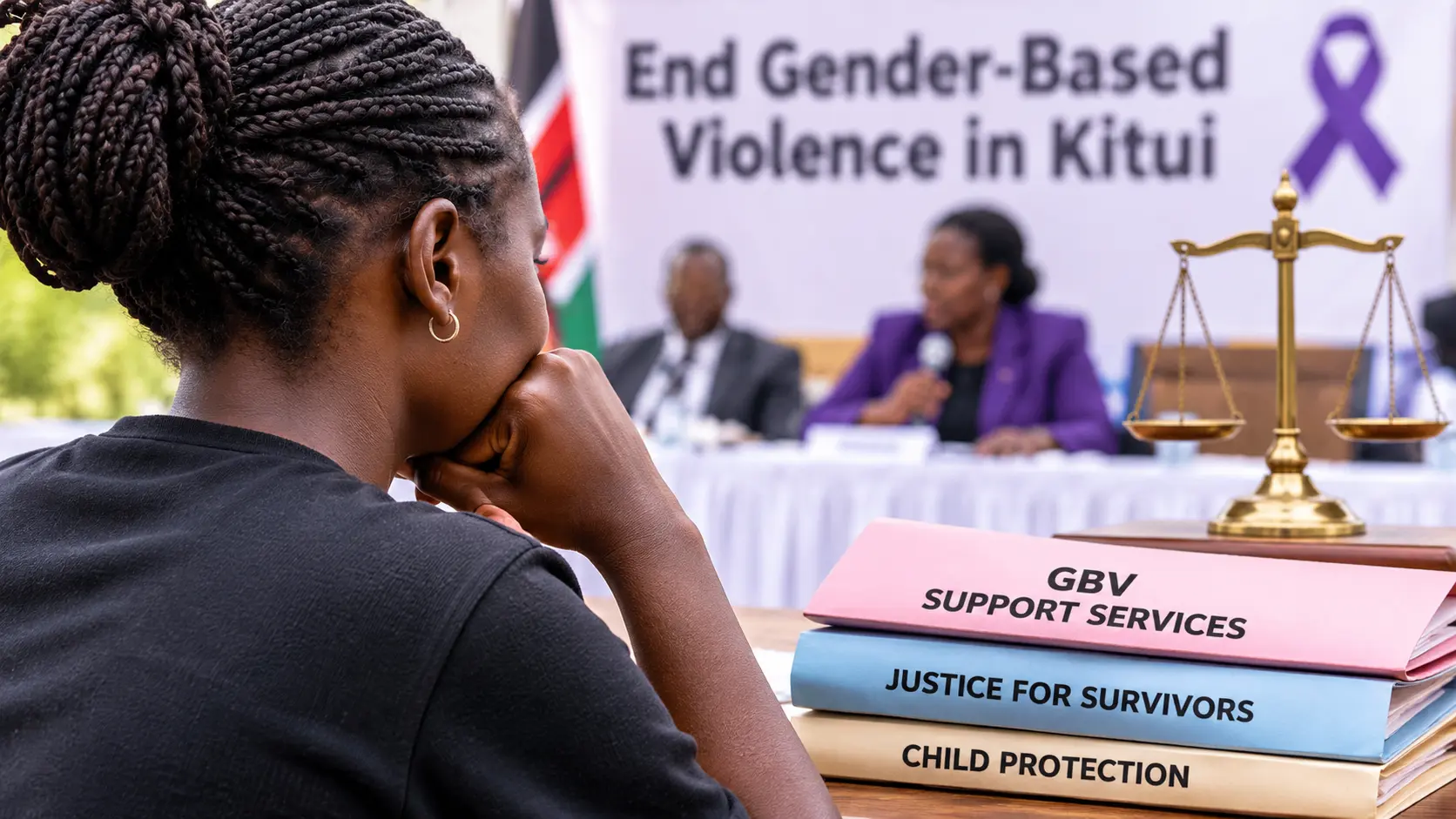
Figures presented during an August 2026 stakeholders’ forum have exposed difficult questions about survivor protection, access to justice and the effectiveness of institutions responding to gender-based violence in Kitui County.
Behind every reported case of sexual and gender-based violence is a survivor whose experience does not end with making a report.
There is the search for medical attention, the need for protection, the possibility of trauma, the pursuit of justice and, in many cases, the difficult question of whether the institutions expected to help will respond in time.
In Kitui County, figures presented during a stakeholders’ engagement forum have offered a sobering picture of the scale of the challenge while raising difficult questions about reporting, access to services and the effectiveness of the county’s response.
Health data covering July 2025 to June 2026 showed that 1,078 survivors of sexual and gender-based violence (SGBV) were recorded across Kitui County during the financial year.
The figures are significant. But beyond the headline number lies a more difficult question: how effectively are the systems established to protect survivors responding to the cases coming through their doors?
The numbers behind the survivors
Of the 1,078 survivors recorded, 395 presented at health facilities within 72 hours of the reported incidents, while 250 were initiated on post-exposure prophylaxis (PEP), a medication intervention used to reduce the risk of HIV infection following possible exposure.
The same data recorded 52 survivors as having completed PEP, 117 as having completed trauma counselling and 139 as having received emergency contraception.
The figures were presented using the Ministry of Health’s MOH 364 reporting tool.
They provide an important snapshot of services recorded during the period, although the different PEP figures should not be interpreted as a direct treatment-completion rate without confirmation that they relate to the same group of survivors.
More importantly, the statistics do not establish how many survivors received comprehensive support, how many were referred to other services or whether those referrals resulted in assistance.
For survivors, timely medical attention is only one part of the journey. Psychological support, protection from further harm and access to justice are equally important components of an effective response.
The courtroom dimension
The challenge extends beyond health facilities and into the justice system, where survivors and their families may have to navigate investigations, court processes and the pursuit of accountability.
During the forum, Kitui Law Courts magistrate Hon. Elizabeth Karani presented figures showing that Kitui Law Courts recorded 115 sexual-offence cases in 2023, 104 in 2024 and 95 in 2025.
The figure for 2026 stood at 47, although the reporting period covered by that tally was not specified during the presentation.
The figures offer a glimpse into the sexual-offence caseload handled specifically at Kitui Law Courts, but they should not be interpreted as a complete measure of the prevalence of sexual violence across Kitui County.
Neither can the 2026 figure be compared directly with previous full-year totals without establishing its cut-off date.
Nevertheless, the statistics place the justice system at the centre of the conversation.
Reporting an offence is only the beginning of a process that should protect survivors, facilitate investigations and ensure that cases are handled through the appropriate legal channels.
How many cases proceed through the justice system? What challenges do survivors encounter while pursuing justice? And how effectively do the institutions involved coordinate their work?
These are important questions that require further examination beyond the figures presented at the forum.
Teenage pregnancy raises another alarm
The forum also examined teenage pregnancy, with county health data for July 2025 to June 2026 showing that adolescents aged 10 to 19 accounted for 21.4 per cent of the pregnant women recorded.
Those aged between 10 and 14 accounted for 1.18 per cent.
The distinction is important. These percentages represent the proportion of recorded pregnant women who were adolescents, not the percentage of all girls in those age groups who became pregnant.
Even with that distinction, the figures underline the need for stronger prevention, protection and support systems for children and adolescents.
Kitui Children’s Office representative Francis Kituku challenged stakeholders to look beyond individual cases and consider the wider risks facing children in affected communities.
He argued that when a child is found in circumstances involving pregnancy or requiring protection, a child-protection file should be opened.
He further emphasised the importance of considering other children who may remain exposed to risk, rather than focusing exclusively on the child whose case has already come to light.
The discussion also addressed situations involving pregnancies between two minors. The guidance given at the forum was that matters involving children under 18 should be reported to the Children’s Office and handled through the appropriate legal and court processes.
The message was clear: child protection must extend beyond responding to an incident to identifying and addressing the circumstances that may expose other children to harm.
Are all cases being captured?
One of the most significant questions raised during the engagement concerned the reliability and completeness of reported cases.
Petronilla Mutua, a participant at the forum, questioned whether the 23 SGBV cases recorded in Mwingi West during the reporting period reflected the full extent of the problem in the area.
She raised concern that some incidents could be going unreported or might not be captured in official records, arguing that more needed to be done to establish the true picture.
Her concern was not proof that cases had been omitted. It nevertheless highlighted a critical weakness that stakeholders must confront: official statistics can only guide effective interventions when cases are reported, documented and properly captured.
A health-sector presentation explained that MOH 364 is a manual data collection tool used by health facilities, with information collected monthly before being uploaded into the digital health information system.
The presenter also explained that SGBV figures are reported cumulatively.
This raises the importance of understanding how cases are documented across facilities and sub-counties, how referrals are tracked and whether different institutions can work from reliable, consistent information.
Without accurate data, areas with weak reporting systems risk appearing to have fewer cases than they actually experience.
That possibility makes data quality a protection issue, not merely an administrative concern.
The duty bearers under scrutiny
These issues formed the centre of the Kitui County Duty Bearers Engagement Forum on strengthening responses to gender-based violence, intimate partner violence and femicide, convened by Savana Kitui Foundation at Lacienda Gardens on August 12, 2026.
The county-level engagement brought together representatives from government departments and institutions involved in prevention, response, protection and accountability.
Hon. Elizabeth Karani, the guest of honour, cautioned that no single institution or gender-based organisation could end gender-based violence on its own.
She called for coordinated action among duty bearers, stressing that meaningful change required institutions and individuals to take responsibility.
“The small change begins with us,” she said.
The panel discussion, moderated by Channel 15 News Chief Editor Erastus Maleve and Savana CBO’s Kelly Josephat, brought together Konari Saidimu, who was then the Assistant County Commissioner for Kitui Central representing the Ministry of Interior; Sally Kako of LRF; Faith Muthale from the Kitui County Government’s Gender Department; and Charles Kyalo Muinde of the National Gender and Equality Commission (NGEC).
Saidimu has since been transferred from Kitui Central.
The composition of the panel reflected the multi-agency nature of the challenge.
The police and administration, health services, county government, child-protection offices, the justice system and oversight institutions all have responsibilities that cannot be effectively discharged in isolation.
Beyond meetings and commitments
The August engagement provided a platform for stakeholders to examine the figures, identify concerns and discuss the responsibilities of institutions charged with protecting survivors.
But the real test of such engagements lies beyond the meeting room.
Can survivors access timely medical care without unnecessary barriers?
Are children at risk identified before further harm occurs?
Are reports consistently captured across health facilities and law-enforcement agencies?
Are survivors supported through the justice process?
And can institutions demonstrate that referrals lead to actual assistance?
These are the questions that must follow the statistics.
The 1,078 recorded survivors are not simply a number on a presentation slide. They represent cases that entered the county’s reporting system and required some form of response.
The figures do not, by themselves, reveal the full extent of violence that may remain unreported. Neither do they establish how effectively every survivor received support.
For Kitui, the challenge is therefore twofold: strengthen the systems that identify and respond to abuse while ensuring that the institutions responsible for protection are held accountable for their actions.
The forum may have ended on August 12, but the questions it raised remain relevant.
Ultimately, the measure of Kitui’s response to gender-based violence will not be the number of meetings convened or commitments announced.
It will be whether a survivor who speaks up finds protection, receives the support they need and can pursue justice without being left to navigate the system alone.
Channel 15 News — The Full Story First.
