


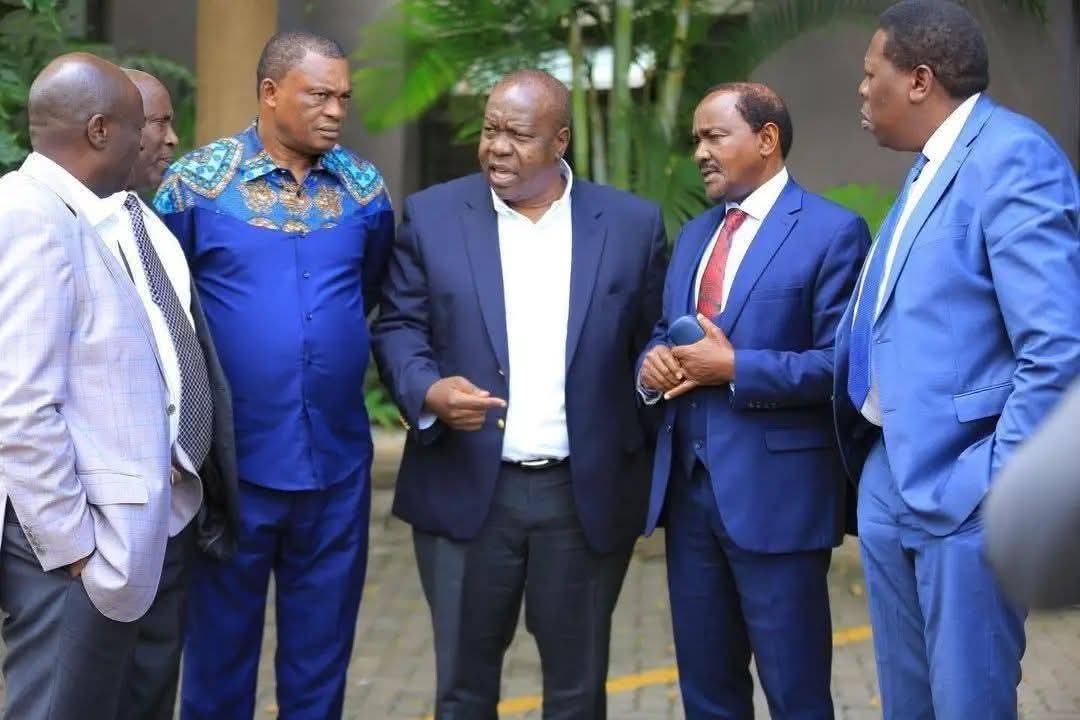
Lawyer Charles Mwalimu, a former Mwingi North UDA parliamentary aspirant, has warned that competing presidential ambitions within Kenya’s opposition could weaken efforts to unseat President William Ruto in the 2027 General Election.
In a political analysis titled “The 2027 Strategic Trap: Why Personal Ambition Assures a William Samoei Ruto Reelection,” Mwalimu argues that opposition leaders may be prioritising their individual political futures over the immediate goal of defeating the incumbent.
He contends that the assumption that anti-Ruto sentiment will automatically unite veteran politicians Kalonzo Musyoka and Rigathi Gachagua with emerging political figures such as Nairobi Senator Edwin Sifuna and former Interior Cabinet Secretary Fred Matiang’i overlooks their competing ambitions and different political timelines.
According to Mwalimu, the opposition’s challenge is not simply assembling a coalition but reconciling the interests of leaders who may each want to occupy the presidency.
The 2032 Succession Question
Mwalimu argues that the prospect of a Kalonzo-led victory in 2027 could complicate the presidential ambitions of younger opposition figures by potentially keeping the presidency within the same political leadership for another decade.

Under his analysis, Sifuna and Matiang’i could face a longer wait for their presidential ambitions if a new opposition president wins in 2027 and subsequently secures a second term.
Conversely, Mwalimu argues that a Ruto re-election could create an open presidential contest in 2032 because the Constitution limits a president to two terms.
He suggests that some opposition figures could therefore see the 2027 election as an opportunity to establish their national political standing ahead of the next succession battle.
However, this remains Mwalimu’s interpretation of political incentives rather than proof that any opposition leader intends to sacrifice a collective victory for personal ambition.
Sifuna and Matiang’i’s Independent Political Paths
Mwalimu points to Sifuna’s Linda Mwananchi movement and The Equitable Party as examples of efforts to build a distinct political identity outside established opposition formations.
He argues that such initiatives could allow Sifuna to develop an independent national support base rather than subordinate his political future to a coalition led by veteran politicians.
Matiang’i’s positioning as a potential presidential contender under the Jubilee Party banner also features prominently in Mwalimu’s analysis.

The lawyer maintains that an independent presidential profile could help Matiang’i establish himself as a serious contender in his own right, rather than remain a junior partner in a coalition dominated by established political figures.
Mwalimu further questions whether an alliance involving Kalonzo and Gachagua would offer a sufficiently coherent political and governance alternative to attract all opposition factions.
The Risk of a Divided Opposition
Beyond individual ambitions, Mwalimu argues that voters seeking political change may be reluctant to embrace a coalition perceived as a rearrangement of familiar political leaders rather than a fundamental departure from established politics.
He contends that emerging opposition figures could see greater long-term value in retaining their distinct identities instead of joining a broad alliance in which their influence and ambitions might be constrained.
Mwalimu also cites purported TIFA polling figures placing Ruto at 24 per cent, Sifuna at 15 per cent, Matiang’i at 14 per cent and Kalonzo at 13 per cent.
The figures, which require verification against the original poll, are presented in his argument as evidence that several opposition figures could have incentives to pursue independent political strategies.
Individual preference figures alone, however, do not establish how candidates would perform in a presidential election or how their supporters might vote if they joined a common coalition.
Will Personal Ambition Decide 2027?
Mwalimu’s central argument is that the 2027 contest could become a battle not only against the incumbent but also among opposition figures seeking to inherit the political space expected to emerge after the next election cycle.
He characterises the election as a potential struggle between Kalonzo’s immediate presidential ambitions and the longer-term succession calculations of politicians such as Sifuna and Matiang’i.
If opposition leaders fail to reconcile those competing interests, Mwalimu argues, Ruto could benefit from a divided field without necessarily having to defeat a unified opposition.
Whether that scenario materialises will depend on coalition negotiations, candidate selection, voter priorities and the political developments leading up to the election.
For now, Mwalimu’s warning presents a central question for Kenya’s opposition: can its leaders agree on a common candidate and political programme, or will the pursuit of individual presidential ambitions undermine their shared objective of challenging Ruto in 2027?
Channel 15 News — The Full Story First.
