


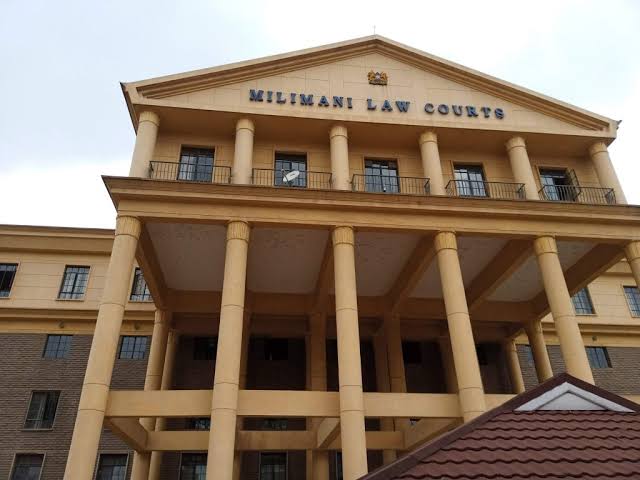
The High Court has issued orders temporarily suspending the operation of the Panel of Experts on Compensation of Victims of Demonstrations and Public Protests, a body recently appointed by President William Ruto to oversee reparations for individuals affected during nationwide protests since 2017.
The suspension follows a petition filed by lawyer Levi Munyeri, who challenged the legality of the panel’s establishment, arguing that its formation contravened constitutional provisions. The orders mean the panel cannot proceed with its mandate until the case is heard and determined.
Gazetted on August 25, 2025, the panel was a high-profile team of 18 experts drawn from diverse fields. At the helm was constitutional law scholar Prof. Makau Mutua, who was appointed chairperson, deputized by Faith Odhiambo Mony, the serving President of the Law Society of Kenya (LSK). The inclusion of figures such as former Solicitor-General Kennedy Ogeto and Amnesty International Kenya’s director Irungu Houghton, who joined in his personal capacity, signaled an attempt to balance government experience with human rights advocacy. The line-up also featured academics and practitioners like Dr. John Olukuru, Rev. Father Kennedy Barasa Simiyu, Dr. Linda Musumba, and Dr. Duncan Ojwang’, alongside public service and development experts including Naini Lankas, Dr. Francis Muraya, Juliet Chepkemei, Pius Metto, Fatuma Kinsi Abass, and Raphael Anampiu. Supporting them were a technical team led by Richard Barno and Dr. Duncan A. Okelo Ndeda, with Jerusah Mwaathime Michael and Dr. Raphael Ng’etich serving as joint secretaries.
The panel’s secretariat was based at the Kenyatta International Convention Centre (KICC) and was tasked with developing a framework for identifying, verifying, categorizing, and compensating victims of protests dating back to 2017. It was also mandated to authenticate data, engage stakeholders, and recommend reforms to reduce future rights violations.
Its formation drew mixed reactions across the country. Supporters praised it as a landmark move to recognize and compensate victims of police brutality during political unrest, with human rights groups welcoming the involvement of respected voices like Irungu Houghton. Critics, however, saw the appointments as politically calculated, questioning whether the president had the constitutional authority to establish such a body. Former Deputy President Rigathi Gachagua and several constitutional scholars went further, branding the initiative unconstitutional and warning it could collapse under legal scrutiny.
With the High Court’s suspension, the work of the panel is effectively frozen until Munyeri’s petition is heard and determined. This leaves the victims — many of whom have waited years for justice — in limbo, and places the entire compensation process under the spotlight. As the legal battle unfolds, the judiciary now holds the key to deciding whether the president’s effort to provide reparations was a bold step toward justice or a constitutionally unsound shortcut.
